THE PRACTICAL GUIDE
Focus: flat dog bed vs bolster bed after surgery, dog bed bolster after TPLO, how thick should dog bed be after TPLO surgery
What is the practical difference?
| Feature | Flat pad or mattress | Bolster bed |
|---|---|---|
| Entry | Usually has no rim to step over. | Requires checking the height and firmness of the raised edge. |
| Crate fit | Often easier to size to a rectangular crate floor. | Bolsters reduce the usable sleeping area and can press against crate walls. |
| Sleeping position | Open surface for stretching out. | Raised sides create a boundary some dogs may prefer. |
| Cleaning | Fewer seams on some designs; check the cover. | More seams and corners may make cleaning more involved. |
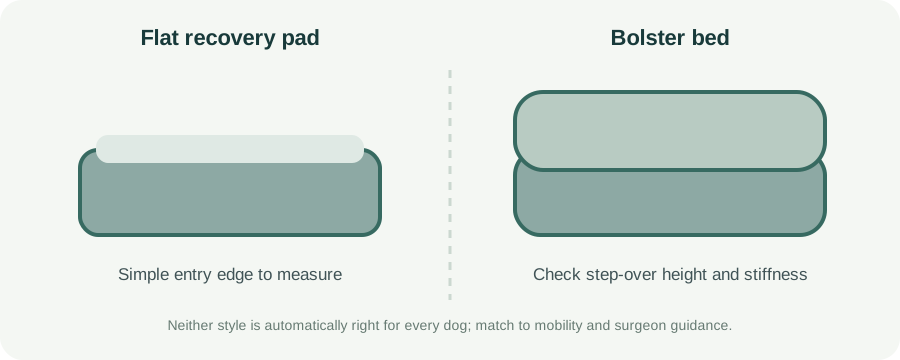
Is a flat bed always safer?
No. Bed shape alone does not determine safety or clinical suitability. A dog with weakness, pain, balance changes or special positioning needs may require individualized bedding advice. Ask the surgeon or rehabilitation team about the specific dog before choosing based on a general rule.
How thick should a recovery bed be?
There is no universal thickness for every dog or procedure. The mattress must fit the crate, allow the door to close normally, and work with the dog’s ability to get onto and off the surface. Ask whether the dog needs a particular level of cushioning or a special pressure-relief surface.
When can a bolster bed be reconsidered?
Only when the care team says the dog can change resting arrangements and the dog can enter and exit without conflict with remaining restrictions. The calendar alone is not clearance.
What should you measure before purchase?
- Usable sleeping surface, excluding bolsters.
- Overall height at the lowest entry point.
- Crate floor dimensions and door clearance.
- Cover removal and washing requirements.
Compare product specifications in the TPLO recovery-bed buying guide , or read the crate-fit measuring method .
Which edge design is easiest to compare?
| Feature | Flat pad / mattress | Bolster bed |
|---|---|---|
| Entry edge | Usually one continuous low surface | May require stepping over a raised rim |
| Sleeping boundary | Open on all sides | Raised sides can create a nest-like boundary |
| Crate fit | Often simpler to size to a rectangular floor | Bolsters reduce usable interior sleeping area |
| Cleaning | Check whether the whole cover removes | Check seams and corners around the bolster |
| Best choice? | Depends on the prescribed setup, dog’s mobility and ability to reposition—not the label alone. | |
How thick should a recovery bed be?
There is no universal thickness that works for every dog, crate and procedure. The finished height needs to fit beneath the door and leave the dog able to use the approved space. The sleeping surface should not bottom out under the dog’s weight, but a very thick mattress may be impractical in a crate. Compare the actual product dimensions and ask the care team when the dog has unusual mobility or support needs.
When might a bolster be appropriate?
A low bolster may be comfortable for some dogs once the surgeon has cleared the relevant movement and the dog can step over it without difficulty. A bed’s attractive raised rim should not take priority over easy access during a restricted period. Reassess the dog’s actual movement and the care team’s instructions before changing bed style.
Veterinary and reference sources
- American College of Veterinary Surgeons: Cranial Cruciate Ligament Disease
- Cornell University College of Veterinary Medicine: TPLO recovery overview
- American College of Veterinary Surgeons: Postoperative Care After Surgery
- American College of Veterinary Surgeons: Canine Hip Dysplasia (hip replacement aftercare context)
- VCA Animal Specialty Group: TPLO recovery and follow-up care
Sources provide clinical context. This site does not provide individualized medical advice or replace discharge instructions.